ENDURANCE & CREW SUPPORT

WHY DEDICATED SUPPORT MATTERS
Ultra-distance and multi-day challenges place very different demands on an athlete from a single training session or race.
As fatigue, cumulative load, changing conditions and reduced recovery begin to stack up, small problems can quickly become much bigger ones.
Dedicated crew support adds another layer to the team — monitoring how the athlete is coping, identifying emerging issues, providing assessment and treatment within professional scope, and helping make informed decisions about what they need before heading back out.
01 — LOAD
How the athlete is responding as distance and fatigue accumulate.
02 — FUEL & HYDRATION
Keeping an eye on intake, hydration and athlete-reported symptoms.
03 — MSK & FEET
Spotting emerging pain, soft-tissue issues and foot problems before they escalate.
04 — RECOVERY
Using the time between sections — or days — to help prepare for what comes next.
CHECKPOINT SUPPORT
A checkpoint is a chance to quickly understand how the athlete is coping, deal with what needs attention and prepare them for the next section — without turning every stop into a treatment session.
01
ARRIVE
Read the athlete first — how are they presenting, what has changed, and what kind of support do they need right now?
02
CHECK
Review emerging pain or symptoms, feet, hydration and intake, and how the athlete is responding to the accumulated load.
03
ACT
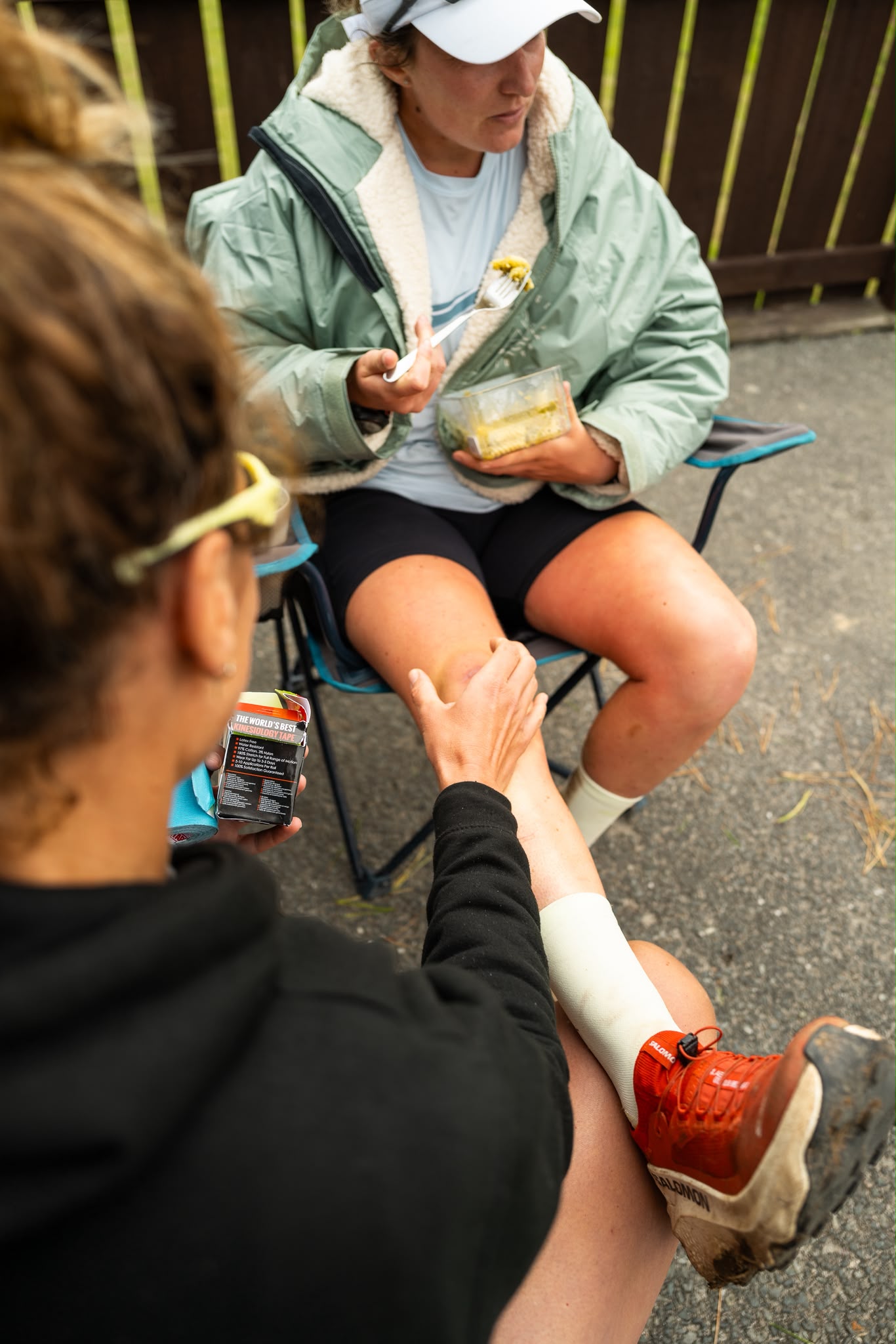
Assessment, treatment, taping, first aid or practical support where appropriate and within professional scope.
04
RESET
Use the available time for recovery, refuelling, rehydration, kit changes and preparation for the next section.
05
GO
Communicate anything relevant with the crew, make sure the athlete has what they need and get them moving again.
ATHLETE-FIRST CREWING
Good checkpoint support is as much about reading the athlete as completing a list of tasks. Some athletes arrive wanting noise, encouragement and conversation. Others need calm, minimal questions and a quiet space to reset. That can change from checkpoint to checkpoint as fatigue builds.
The setup, communication and even the size and make-up of the crew can be shaped around the athlete — creating the environment they need at that point in the challenge.
Not every checkpoint needs every step. Support adapts to the athlete, the challenge and what is happening on the day.
MONITORING ACROSS THE CHALLENGE
On a long or multi-day challenge, what happens at one checkpoint only tells part of the story. Consistent monitoring across the route can help build a clearer picture of how the athlete is responding as the miles, hours and days accumulate.
I use a simple athlete monitoring system to record relevant information consistently across checkpoints — helping identify changes, spot emerging patterns and give the crew useful continuity from one section to the next.
01 — ATHLETE PRESENTATION
How the athlete is feeling, communicating and coping compared with earlier checkpoints.
02 — PAIN & MOVEMENT
Tracking emerging symptoms and changes in movement or function across the challenge.
03 — FUEL, FLUID & RECOVERY
Recording athlete-reported intake, hydration and recovery information to help identify changes over time.
04 — FEET & PHYSICAL LOAD
Keeping track of foot issues and relevant physical signs as cumulative load increases.
YES, THERE’S A SPREADSHEET.
A simple shared monitoring record gives the crew something more reliable than memory alone — particularly during long, overnight or multi-day challenges when fatigue affects everyone, not just the athlete.
Monitoring supports decision-making; it doesn’t replace clinical assessment, medical care or appropriate referral when required.
BUILT AROUND THE ATHLETE
Good crewing isn’t just about having enough people at a checkpoint. It’s about having the right people, clear roles and an environment that works for the athlete.
I can work alongside an athlete’s existing crew or help shape the support setup around the challenge — from checkpoint roles and communication to practical athlete support and continuity between stops.
For some athletes that means a bigger, high-energy team. For others, a smaller, quieter setup with minimal fuss works better. The crew environment should fit the athlete — not the other way around.
01 — EXISTING CREW
Slot into an established team and work alongside the people who already know the athlete.
02 — CREW STRUCTURE
Help establish clear checkpoint roles, communication and handovers.
03 — ATHLETE-FIRST
Shape the size, make-up and atmosphere of the crew around the person doing the challenge.
FLEXIBLE ENDURANCE SUPPORT
From a single-day ultra to an FKT attempt or a multi-day endurance project, the support required can look completely different.
Cover can be built around the route, athlete, existing crew and demands of the challenge — whether that means managing checkpoints, travelling with the crew, monitoring across multiple days, providing hands-on support or combining several roles.
The starting point is the challenge. We build the support around it.
01 — ULTRAS & LONG-DISTANCE EVENTS
Checkpoint and athlete support across a single long day or overnight challenge.
02 — FKT & PERSONAL CHALLENGES
Flexible support for projects where the route, timings and demands don’t follow a standard event format.
03 — MULTI-DAY CHALLENGES
Continuity across consecutive days, tracking how the athlete is responding as fatigue and load accumulate.
04 — EXISTING CREW SUPPORT
Add clinical and athlete-support experience to an established crew without unnecessarily changing what already works.

CLINICAL SUPPORT IN THE FIELD
An embedded soft tissue therapist can bring another layer of practical athlete support to an endurance crew — without turning every checkpoint into a treatment session.
Assessment, treatment and monitoring sit alongside the ordinary jobs that keep a challenge moving: sorting kit, managing checkpoints, helping with fuelling and hydration, communicating with the crew and getting the athlete ready for the next section.
The clinical role sits inside the crew role — not instead of it.
01 — MSK ASSESSMENT
Assessment of emerging musculoskeletal problems within professional scope.
02 — SOFT TISSUE TREATMENT
Level 5 advanced soft tissue treatment where appropriate and useful.
03 — TAPING
Practical taping support where appropriate.
04 — ATHLETE MONITORING
Track symptoms, physical presentation and changes across successive checkpoints.
05 — FEET & BLISTERS
Monitor developing foot problems and provide appropriate practical support within scope.
06 — WARM-UP & RECOVERY
Mobility, warm-up and recovery support around the demands of the challenge.
07 — FIRST AID
First-aid support within current qualification and professional scope.
08 — ESCALATION & REFERRAL
Recognise when a problem requires medical assessment, referral or a change of plan.
09 — CREW & CHECKPOINT SUPPORT
Work as part of the crew with checkpoint setup, kit, athlete handovers and the practical jobs required to keep the challenge moving.
Sometimes the athlete needs assessment or treatment. Sometimes they need their bottles filled, their coat found and everyone to stop talking for five minutes. Good support is knowing the difference.
ENDURANCE SUPPORT OPTIONS
No two endurance projects look quite the same. Support can be built around the route, duration, athlete, existing crew and demands of the challenge — from a single long day to consecutive days on the move.
01 — SINGLE-DAY & EVENT SUPPORT
Dedicated support for ultras, endurance events and long single-day challenges. This can include checkpoint support, athlete monitoring, soft tissue treatment within scope, taping, first aid, fuelling and hydration support, and working alongside the wider crew.
02 — MULTI-DAY & FKT SUPPORT
Continuity across consecutive days, with structured athlete monitoring to help identify changes as fatigue and load accumulate. Support can include checkpoint management, recovery, treatment within scope, foot care, first aid and communication with the wider team.
03 — JOIN YOUR EXISTING CREW
Already have a crew? I can slot into an established team and add athlete-focused support without taking over the operation — helping with checkpoints, monitoring, treatment, recovery and the practical jobs that keep the challenge moving.
The starting point is the challenge, not a package. Tell me what you’re planning, where you’re going and what support you already have. From there we can work out what would genuinely be useful.
EXPERIENCE FROM BOTH SIDES

My crew experience includes managing athlete support across a multi-day South West Coast Path FKT attempt, working across checkpoints, monitoring, treatment, recovery and the practical jobs that keep an athlete moving.
ATHLETE
Ultras • Marathons • Triathlon • Multi-day endurance
CREW
FKT • Ultra • Multi-day checkpoint support
PRACTITIONER
Level 5 Advanced Soft Tissue Therapist
MSc Sports Rehabilitation — currently studying
GOT SOMETHING IN MIND?